
Orthotic Devices Market to Reach USD 10.28 Billion by 2031, Driven by Rising Mobility Needs and Digital Customization
Hyderabad – Nov. 23, 2026 –
Orthotic Devices Market Overview
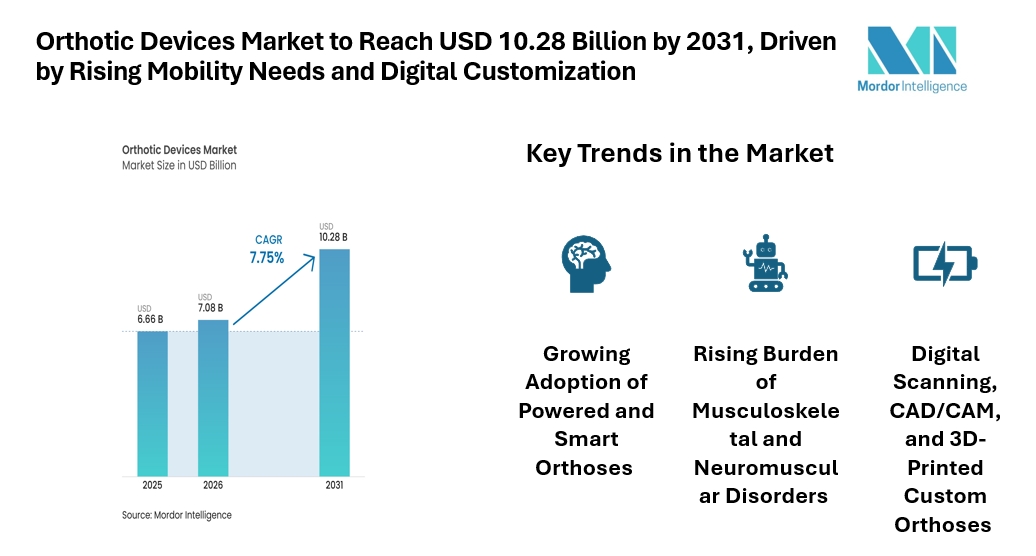
According to Mordor Intelligence, the orthotic devices market size is estimated at USD 7.08 billion in 2026 and is projected to reach USD 10.28 billion by 2031, registering a CAGR of 7.75% during the forecast period. The market was valued at USD 6.66 billion in 2025, reflecting continued demand for devices that support mobility, alignment, and rehabilitation.
The growing prevalence of musculoskeletal and neuromuscular disorders is supporting demand for clinically fitted orthoses across healthcare settings. Aging populations, diabetes-related complications, sports injuries, and post-surgical rehabilitation are also contributing to device requirements. Healthcare delivery is increasingly emphasizing non-surgical mobility care and home-based rehabilitation, creating opportunities for customized and technologically advanced products.
North America held the largest regional share of the orthotic devices market, while Asia-Pacific is expected to register the fastest growth during the forecast period. Digital scanning, computer-aided design, and 3D printing are also influencing product development by enabling more customized devices and improving manufacturing workflows.
Report Overview: https://www.mordorintelligence.com/industry-reports/orthotic-devices-market?utm_source=abnewswire
Orthotic Devices Market Trends
Rising Burden of Musculoskeletal and Neuromuscular Disorders
The increasing prevalence of musculoskeletal conditions is a major factor supporting orthotic devices market growth. Conditions such as osteoarthritis, spinal disorders, and joint injuries create demand for devices that improve alignment, provide support, and assist mobility. Neurological conditions, including stroke, cerebral palsy, and multiple sclerosis, also require long-term orthotic support.
These conditions often involve ongoing rehabilitation and periodic device replacement as patients’ functional requirements change. The need for customized solutions across different age groups and clinical applications is therefore supporting demand for lower-limb, upper-limb, and spinal orthoses.
Digital Scanning, CAD/CAM, and 3D-Printed Custom Orthoses
Digital scanning and computer-aided manufacturing are improving the design and production of customized orthotic devices. These technologies allow manufacturers and clinicians to develop devices based on individual anatomical requirements, supporting improved fit and patient comfort.
The use of 3D printing is also expanding across upper-limb and spinal orthoses. Digital production workflows can improve manufacturing consistency and reduce turnaround times. These capabilities are particularly relevant for pediatric patients who may require replacement devices as they grow, as well as patients who need specialized designs for complex mobility conditions.
Growing Adoption of Powered and Smart Orthoses
Powered and smart orthotic devices are gaining attention as manufacturers incorporate sensors, monitoring capabilities, and electrical stimulation technologies into rehabilitation products. These systems can support gait monitoring, movement assistance, and more personalized rehabilitation approaches.
Functional electrical stimulation is also expanding the role of orthotic devices in neurological care. By supporting muscle activation and movement, these technologies offer additional options for patients with neuromuscular impairments. Growing interest in clinically integrated devices is expected to support demand for advanced orthotic solutions.
Expansion of Home-Based Rehabilitation and Mobility Care
Healthcare providers are increasingly emphasizing rehabilitation and mobility support outside traditional hospital settings. Homecare services can help patients continue treatment and manage long-term mobility requirements through fitted orthoses and follow-up care.
Digital scanning and teleconsultation are supporting this shift by making device assessment and monitoring more accessible. The expansion of home-based care is particularly relevant for older adults and patients with chronic conditions who require ongoing support. This trend is creating opportunities for manufacturers and care providers to strengthen distribution and patient-service networks.
Orthotic Devices Market Segmentation
The orthotic devices market is segmented by product type, functionality, application, age group, end user, and geography.
-
By Product Type
-
Lower-Limb Orthotic Devices
-
Upper-Limb Orthotic Devices
-
Spinal Orthotic Devices
-
By Functionality
-
Conventional Orthotic Devices
-
Dynamic Orthotic Devices
-
Powered and Smart Orthotic Devices
-
By Application
-
Musculoskeletal Disorders
-
Neuromuscular Disorders
-
Sports Injuries and Trauma Rehabilitation
-
Diabetic Foot and Neuropathy
-
Post-Surgical and Age-Related Mobility Disorders
-
By Age Group
-
Pediatric
-
Adult
-
Geriatric
-
By End User
-
Hospitals and Clinics
-
Orthotics and Prosthetics Clinics
-
Rehabilitation Centers
-
Homecare Settings
-
Sports and Specialized Care Centers
-
By Geography
-
North America: United States, Canada, and Mexico
-
Europe: Germany, United Kingdom, France, Italy, Spain, and Rest of Europe
-
Asia-Pacific: China, Japan, India, South Korea, Australia, and Rest of Asia-Pacific
-
Middle East and Africa: GCC, South Africa, and Rest of Middle East and Africa
-
South America: Brazil, Argentina, and Rest of South America
For more insights on the Japanese market report, please visit the Mordor Intelligence page: https://www.mordorintelligence.com/ja/industry-reports/orthotic-devices-market?utm_source=abnewswire
Orthotic Devices Market Competitive Landscape
The orthotic devices market is moderately concentrated, with established manufacturers competing through product development, clinical networks, and specialized mobility solutions. Companies are expanding their portfolios across lower-limb, upper-limb, and spinal orthoses while incorporating digital manufacturing and smart-device capabilities.
Strategic acquisitions and partnerships are also supporting market development. Manufacturers are strengthening their clinical service networks and expanding access to specialized products, particularly for neurological rehabilitation and complex mobility needs. Product customization, clinical evidence, reimbursement access, and patient support remain important competitive factors.
Key Players in the Orthotic Devices Market
-
Ottobock SE & Co. KGaA
-
Össur hf.
-
Enovis Corporation
-
Bauerfeind AG
-
Breg, Inc.
-
Hanger, Inc.
-
Thuasne Group
-
Fillauer LLC
-
Blatchford Group
-
medi GmbH & Co. KG
Conclusion
The orthotic devices market is expected to maintain its growth trajectory as demand increases for mobility support, rehabilitation, and customized treatment solutions. The growing burden of musculoskeletal and neuromuscular disorders, combined with advances in digital manufacturing and smart orthotic technologies, is broadening the range of clinical applications.
North America is expected to retain its leading regional position, while Asia-Pacific is projected to offer the fastest growth opportunities. Manufacturers that focus on customization, clinical integration, and accessible patient-care networks are positioned to address evolving demand across healthcare settings.
About Mordor Intelligence
Mordor Intelligence is a global market intelligence firm, founded in 2014, helping businesses make informed decisions through data-driven insights, industry expertise, and advanced analytics. With 550+ domain experts and on-ground specialists across 150+ countries, the company delivers comprehensive intelligence across aerospace & defense, agriculture, automation, automotive, chemicals & materials, consumer goods & services, electronics, energy & power, financial services, food & beverages, healthcare, hospitality & tourism, information & communications technology, and logistics.
Its offerings include syndicated industry reports and subscription platforms such as Synapse. Mordor Intelligence is ISO 9001:2015 and ISO/IEC 27001:2022 certified, a member of ESOMAR and the Market Research Society of India, and a four-time Great Place to Work® honoree. Learn more at mordorintelligence.com.
Media Contact
Company Name: Mordor Intelligence Private Limited
Contact Person: Jignesh Thakkar
Email: Send Email
Phone: +1 617-765-2493
Address:11th Floor, Rajapushpa Summit, Nanakramguda Rd, Financial District, Gachibowli
City: Hyderabad
State: Telangana 500008
Country: India
Website: https://www.mordorintelligence.com/


